Behind the Resin Procurement Watch
Written by Zac Ruiz.
How a real resin procurement ask became a public page, and where human review changed the result.See how a real procurement ask became the public Resin Procurement Watch (beta).
If you want the bounded beta read, the thresholds, and the scorecard, start there. This page shows how the resin page got built: the email with Aaron, the key refinements, the public-data method, the lineage view, and the review loop that kept the claims tight.
Published with permission. Company-specific data and contract terms are omitted.
Why publish the working process
The public page and this post do different jobs. The page preserves the April 10, 2026 snapshot. This post shows the working process behind it.
That split matters because Cairn is most useful when the original request stays visible.
The starting point
Aaron gave Cairn a concrete hypothetical to work against:
"For our hypothetical scenario, let's say I purchase thermoplastic resins (high density polyethylene and polypropylene) ... Primary contract cadence is typically 12-24 months with price resets every 3 months."
That moved the conversation out of generic procurement language and into a specific operating question: category, cadence, reset behavior, and why timing mattered.
Specificity is what makes the harness useful.
A few exchanges that shaped the work
The work got better through a few short turns:
Working session: "Category cost pressure" is a good frame, but "we need 72-hour lead time on resin price moves because our packaging supplier passes through quarterly" is a use case we can nail.
Human correction: "we aren't really watching those things ... draft something specific"
Aaron later: "what we are really looking for is having the directional framework that can be used ... in a real world scenario with client specific data"
That is the Cairn loop in practice: the email sets the mechanism, the harness keeps continuity, and review cuts overreach.
What Cairn actually did
The work was practical:
- held onto the live email as the business context
- pulled prior session context from the working history
- mapped the ask to one narrow first-pass page
- produced draft explanations and follow-up questions
- stayed close enough to human review to correct overreach
At one point a draft drifted toward a broader claim about what we were actively monitoring. The correction was immediate:
"we aren't really watching those things ... draft something specific"
That is the behavior we want. The value is in continuity and revision, not unreviewed claims.
Why the first-pass methodology stayed narrow
The public resin page was deliberately simple.
It used a weighted composite of three public inputs on trailing three-month rolling averages:
When the absolute composite change crossed 3% at month-end, the page produced a directional read. That read was then compared with the realized quarterly high-density polyethylene resin producer-price index from BLS.
On the first historical pass, the direction matched 121 of 213 scored events, or 56.8%.
Good enough for a beta proof case. Not a production claim.
The lineage view in CMD+RVL's metadata catalog
The resin page is not just a chart with a paragraph under it. It sits in CMD+RVL's metadata catalog with lineage across source files, source tables, staging tables, the monitor table, the realizeds table, and the public-facing signal tables.
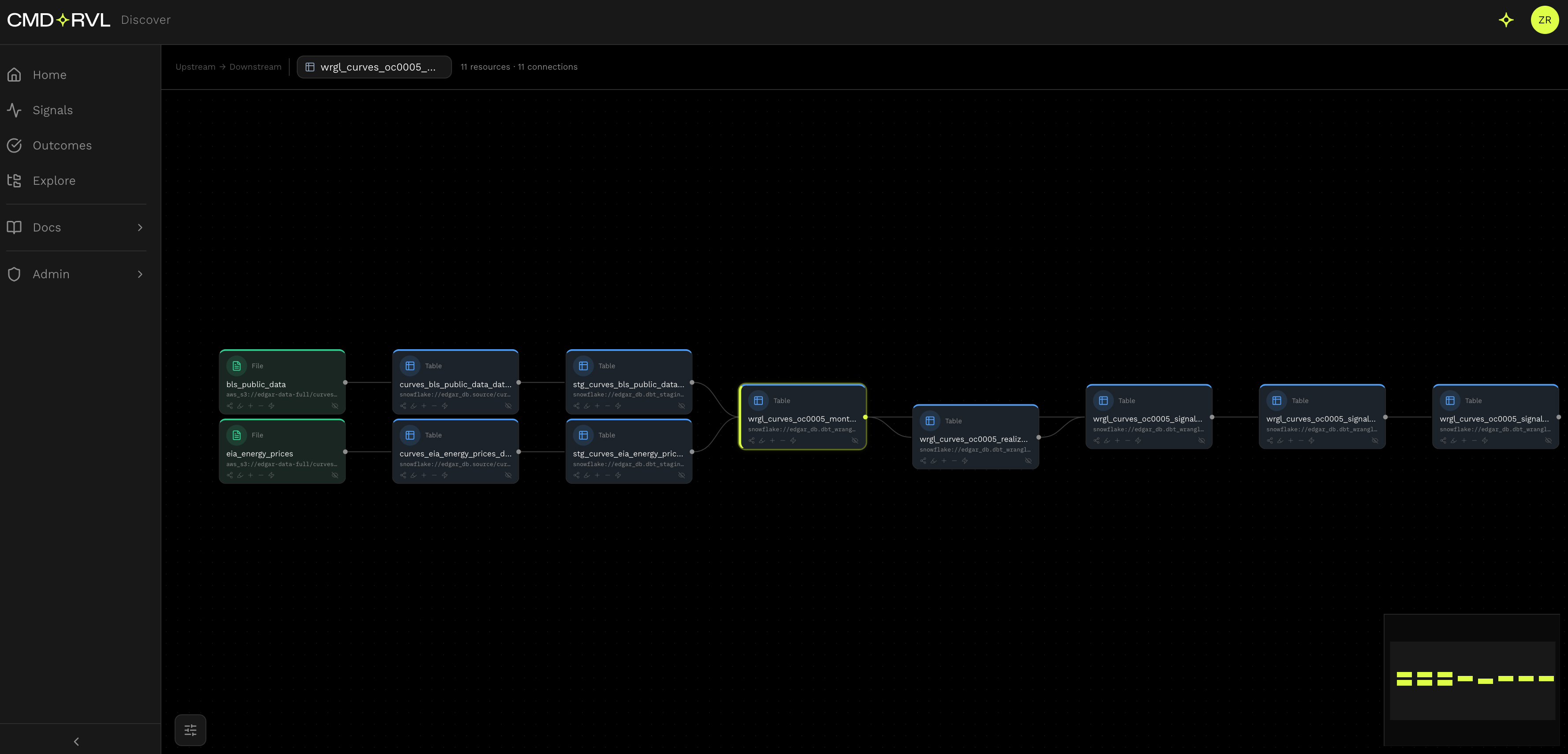
Upstream-to-downstream lineage for the resin pipeline in CMD+RVL's metadata catalog.
That view matters because it shows the work as a chain, not just an output. A person can inspect it. An agent can inspect it. The same structure is what makes the AI companion useful instead of loose.
The second pass made the public page more realistic
The next refinement was a utilization gate, using the Federal Reserve's chemical manufacturing capacity-utilization series. Above roughly 76%, suppliers had more pricing power. Below it, the same feedstock move was less useful.
That changed the interpretation:
- higher-utilization periods kept the directional framework usable
- lower-utilization periods produced too many bad calls
- when utilization dropped below the threshold, the page stayed yellow instead of being pushed forward as if it were equally credible
That is why the April 10, 2026 public snapshot was yellow: wait.
What powered the interaction
The output came from four things working together:
- the original email, which carried the live business question
- public data inputs, which gave us a defensible first-pass page
- CMD+RVL's metadata catalog, lineage, and session history, which preserved context across iterations
- human review, which corrected framing and kept the scope honest
Aaron later captured the right boundary in the email:
"what we are really looking for is having the directional framework that can be used ... in a real world scenario with client specific data"
That is the split. The public-data version is the proof case. The client-specific version is the larger private implementation.
What would make this ready for a larger private implementation
To move from a public framework to a live private implementation, we would want:
- actual procurement timing instead of assumed cadence
- the specific resin grades being purchased
- one real contract formula or reset rule
- clarity on whether imported PE or PP is shaping supplier behavior
- a clear answer on whether the team wants fewer high-confidence alerts or broader directional coverage
That is where the work stops being a public framework and starts becoming an operating workflow.
Light disclaimers
This post is intentionally bounded.
- The scenario is hypothetical.
- The data is incomplete.
- The public page is not a live procurement monitoring service.
- Cairn did not act alone; the output was reviewed and corrected by a human operator.
Those are part of the proof, not something to hide.
Why this post is in the portfolio
We are publishing this because it shows the kind of work Cairn is good at:
- a real inbound email
- a specific operator question
- a first-pass page built from public inputs
- a visible methodology
- a visible lineage chain
- a visible correction loop
- a clear path from proof case to a larger private implementation
That is our version of a case study.
If you want the page itself, see Resin Procurement Watch (beta). If you want to test Cairn on a live category or operator workflow, ask us about a live question.

Zac Ruiz
Co-Founder
Technology leader with 25+ years' experience, including a decade in securitization and capital markets.
LinkedIn